Is Charcoal Toothpaste Bad for Your Teeth? What a Cosmetic Dentist Wants You to Know
Charcoal toothpaste sells a black paste that promises white teeth. Here is what it actually does to enamel, why the missing fluoride matters more than the abrasion, and what genuinely brightens a smile.
Charcoal toothpaste is not good for your teeth, and for most people it is mildly bad. Activated charcoal removes surface stain by abrasion rather than by bleaching, the majority of charcoal pastes contain no fluoride, and daily use over years can wear away enamel and dentine that never grow back. Occasional use is unlikely to harm you. Daily use is not worth the risk.
That is the short answer, and it is the one I give patients in the chair before we get into the detail. The longer answer is more interesting, because charcoal toothpaste fails in a way that most people never suspect. It does not just risk damaging your teeth. Over time, it can make them look yellower.
What does charcoal toothpaste actually do to your teeth?
Activated charcoal is carbon that has been treated to make it extremely porous. In medicine it is used to bind toxins in the gut, and that adsorbent property is what the marketing borrows from. Toothpaste is a different environment entirely. Charcoal spends around two minutes in contact with a hard, non-porous mineral surface, and there is no meaningful evidence that it pulls anything out of enamel.
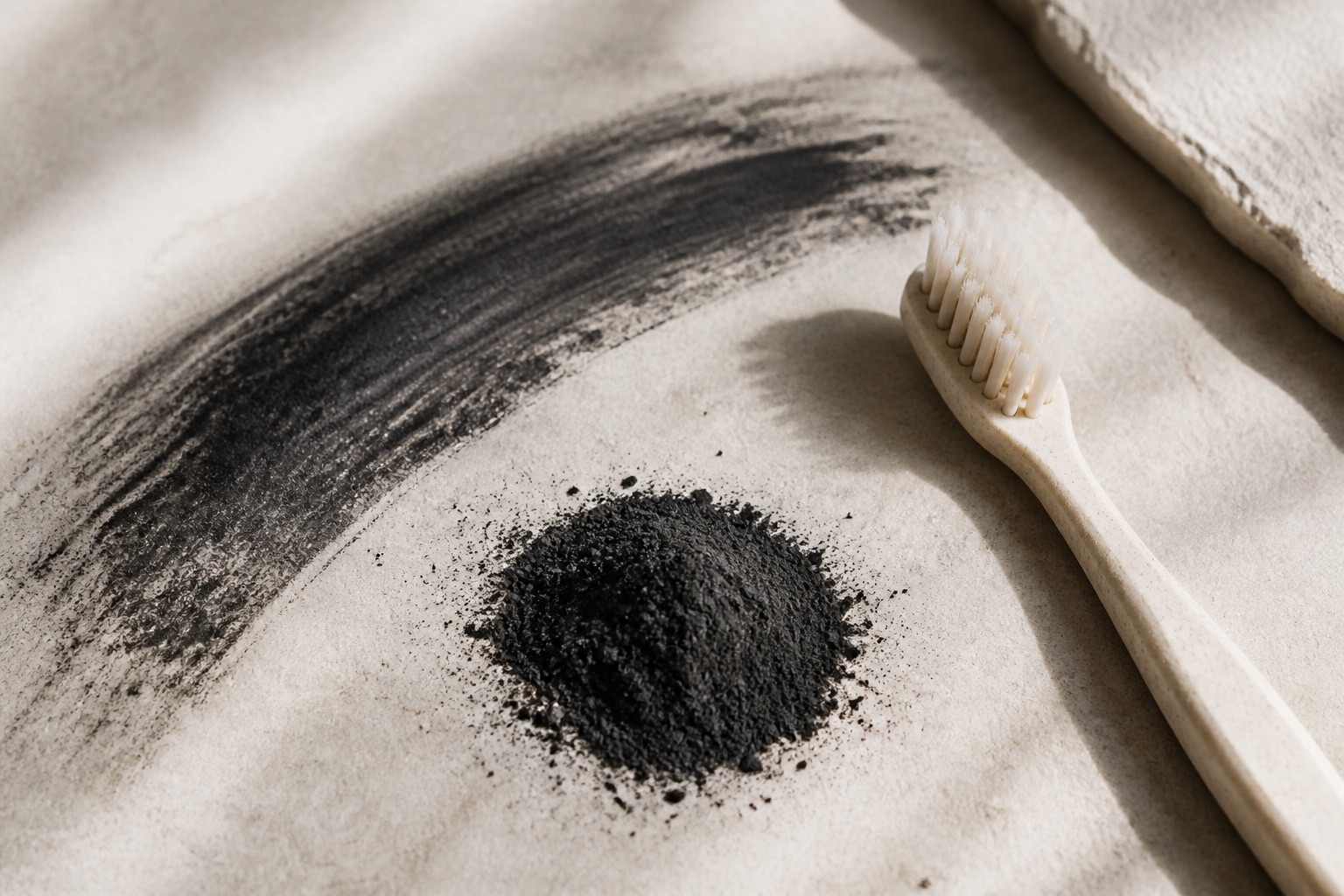
What it does do is scrub. Charcoal particles are hard and irregular, and they work the same way a scouring powder works on a pan: they physically abrade the outer layer of whatever they touch. If you have coffee, tea, red wine or tobacco stain sitting on the surface of your enamel, charcoal will take some of it off. Your teeth genuinely look a little cleaner. The problem is that abrasion is indiscriminate. It removes the stain, then it keeps going.
Is charcoal toothpaste abrasive enough to damage enamel?
Toothpaste abrasiveness is measured on the RDA scale (Relative Dentin Abrasivity). Anything up to 250 is considered safe for lifetime use by international standards, with under 70 counted as low abrasion and 100 to 150 counted as high. The difficulty with charcoal products is that they are wildly inconsistent. Independent testing has found charcoal pastes scattered across almost the entire scale, from gentle formulations that sit below 70 to products that push into the upper bracket. The tube almost never tells you which one you have bought.
Enamel is the hardest tissue in the human body, roughly 96% mineral, and it does not regenerate. There are no cells inside it to rebuild what you remove. It is also not uniformly thick. Over the biting surface of a molar you may have 2 to 2.5 mm of it. At the gumline it can be as thin as 0.3 mm, and that thin cervical band is precisely where most people brush hardest. Enamel is thought to wear at somewhere between 20 and 40 microns a year through ordinary chewing alone. Add a firm brush, a heavy hand and an abrasive paste twice a day, and you accelerate a process that was already running.
Charcoal doesn't whiten your teeth. It sands the stain off them, and it has no idea when to stop.
Underneath the enamel is dentine, which is considerably softer and naturally yellow-brown. Once abrasion exposes it at the gumline, two things happen at once. The tooth starts to look darker, because you are now seeing dentine through a thinner window. And it becomes sensitive, because dentine contains microscopic tubules that connect to the nerve. Patients often arrive convinced their teeth have suddenly stained. What has actually happened is that the enamel has thinned and the colour underneath is showing through.
Why does the missing fluoride matter more than the abrasion?
This is the part that gets overlooked. When researchers have surveyed charcoal dentifrices on the market, the consistent finding is that most of them contain no fluoride at all, or contain it in a form or quantity unlikely to do much. In one widely cited review of charcoal toothpastes sold in the UK, fewer than one in ten carried fluoride at a therapeutic level, while nearly all of them made a whitening claim.
A standard adult toothpaste delivers 1,350 to 1,500 ppm fluoride. That number is one of the best-evidenced interventions in all of dentistry. It slows demineralisation, helps remineralise early lesions before they become cavities, and it works quietly every single day. Swapping a fluoride paste for a charcoal one to chase a cosmetic effect means trading proven decay protection for unproven whitening. In clinic, the cavities I see from that trade cost far more to fix than any stain would have.
Does charcoal toothpaste actually whiten teeth?
Not in the way people mean. There are two kinds of tooth discolouration. Extrinsic stain sits on the outside, picked up from coffee, tea, red wine, curry, smoking and certain mouthwashes. Intrinsic colour is the colour of the tooth itself, largely determined by the dentine underneath, and it deepens naturally with age.
Charcoal can only touch the first category, and only by scrubbing. It contains no peroxide, so it cannot alter intrinsic colour at all. Real whitening works chemically: hydrogen peroxide or carbamide peroxide diffuses through the enamel and breaks down the pigmented molecules held inside the tooth structure. That is a genuine colour change, not a cleaning.
Worth knowing if you are shopping in Europe: EU cosmetic regulations cap over-the-counter whitening products at 0.1% hydrogen peroxide, while a registered dental professional may use up to 6%. That is a sixtyfold difference in active concentration, and it explains why shop-bought whitening products underdeliver while professional teeth whitening produces a visible shift. It is also why the first application legally has to be carried out by, or under the supervision of, a dentist.
How does charcoal compare with the alternatives?
| Approach | How it works | Effect on intrinsic colour | Enamel risk | Typical cost |
|---|---|---|---|---|
| Charcoal toothpaste | Abrasion of surface stain | None | Moderate to high with daily long-term use; usually no fluoride | €8–€15 per tube |
| Fluoride whitening toothpaste | Mild abrasives plus stain-dispersing agents, with decay protection | Minimal | Low when RDA is stated and moderate | €4–€12 per tube |
| Professional hygiene visit | Ultrasonic scaling and air polishing removes stain and calculus | None, but restores the tooth's true shade | Very low | €70–€150 per visit |
| Supervised whitening (in-clinic or custom trays) | Peroxide breaks down pigment inside the tooth | Genuine shade change, several levels | Low; transient sensitivity is common | €300–€600 in Spain |
| Porcelain veneers | Replaces the visible surface with hand-layered ceramic | Complete control of shade, shape and texture | Depends entirely on preparation depth | Premium tier, quoted per case |
Is charcoal toothpaste safe if you have veneers, bonding or crowns?
No, and this is where I am least flexible with patients. Restorative materials respond to abrasion differently from enamel, and none of them respond well.
Porcelain carries a fired surface glaze. That glaze is what makes light behave correctly on the tooth: the slight sheen, the way the surface catches and scatters light rather than looking flat. Abrasive pastes dull it. A dulled veneer does not look damaged in any obvious way, it just looks lifeless, and once the glaze is gone it cannot be brushed back.
Composite bonding is more vulnerable still, because composite resin is softer than both porcelain and enamel. Abrasive paste roughens the surface, and a roughened surface picks up stain faster than a polished one. You end up brushing more aggressively to fight discolouration that the brushing itself created.
There is also a purely cosmetic problem. Charcoal particles are black, they are small, and they lodge in exactly the places you do not want black particles: the margin where a restoration meets the tooth, the tiny gap at the gumline, hairline surface cracks. I have seen patients with beautifully made ceramics outlined in fine grey stippling, which reads to the eye as a dark line around every tooth.
What should you use instead?
The honest home routine is unglamorous and it works.
- A fluoride toothpaste at 1,350 to 1,500 ppm, twice daily. Spit, do not rinse, so the fluoride stays on the teeth.
- A soft-bristled brush, electric if possible, held with light pressure. Most electric brushes now have a pressure sensor. Trust it.
- Clean between the teeth daily. Interdental brushes where the spaces allow, floss where they do not. Most visible staining between front teeth is stain nobody ever disturbs.
- Rinse with water after coffee, tea, red wine or citrus. Wait around 30 minutes before brushing after anything acidic, since enamel is temporarily softened and brushing straight away removes more of it.
- Book a hygiene visit every six months. A single professional clean removes more genuine stain than a year of charcoal.
If you have used charcoal paste occasionally, there is no need for alarm. Stop, switch back to fluoride, and mention it at your next check-up so the enamel at your gumlines can be assessed. If you have used it twice daily for years and you have noticed sensitivity to cold or a yellow band appearing near the gum, that is worth a proper look.
When is the discolouration not a toothpaste problem at all?
Plenty of people arrive at our studios in Marbella, Estepona and Riviera del Sol having tried every whitening product on the shelf, frustrated that nothing worked. Frequently nothing worked because the cause was never surface stain. It might be tetracycline banding from childhood antibiotics, fluorosis, a tooth that darkened after trauma, ageing composite fillings that have discoloured while the natural teeth around them have not, or simply enamel that has thinned enough to reveal the dentine beneath. No toothpaste of any colour addresses those.
That distinction is one of the things Dr Ace Korkchi built into the ACE Smile Index, the published ten-criteria framework we assess every case against. It separates what is genuinely a surface issue from what is structural, so that treatment matches the actual cause rather than the loudest symptom. Sometimes the answer is a hygiene appointment and a change of toothpaste. Sometimes it is supervised whitening. Sometimes it is conservative, minimal-prep ceramics, hand-layered by our own master ceramists in our own laboratories, delivered across two to three visits over roughly a month.
What we will not do is sell you the more complex option when the simpler one is correct. Our patients have left more than 200 Google reviews, and a fair share of them come from consultations where the recommendation was to change one habit and come back in six months.
So, the verdict on charcoal
Charcoal toothpaste is a cosmetic product wearing a health product's clothing. It offers a mild, temporary cleaning effect that a professional hygiene visit does better and more safely, while withholding the one ingredient in toothpaste with decades of evidence behind it. Used now and then it is a harmless indulgence. Used every day for years it quietly trades enamel, the very thing that makes teeth look bright, for the appearance of brightness.
If your teeth are not the colour you want, that is a reasonable thing to want changed, and there are honest ways to change it. Start with a clean and a conversation. The black paste is not one of them.
Direct Answers
- Can charcoal toothpaste permanently damage enamel?
- Yes, in the sense that any enamel removed by abrasion does not grow back. Enamel contains no living cells and cannot repair itself the way bone does. Occasional use is very unlikely to cause noticeable harm, but abrasive brushing twice daily over several years can thin the enamel at the gumline, where it may be only around 0.3 mm thick, leading to sensitivity and a darker appearance.
- How often can I use charcoal toothpaste safely?
- If you want to keep using it, treat it as an occasional product rather than a daily one, perhaps once a week, and always brush with a fluoride toothpaste the rest of the time. Never use it with a hard brush or heavy pressure. If you have veneers, crowns, bonding or exposed root surfaces, it is better avoided altogether.
- Does charcoal toothpaste remove coffee and wine stains?
- It can lift some surface staining from coffee, tea and red wine by abrasion, which is why people notice a mild improvement in the first week or two. It cannot reach staining that has penetrated the tooth, and it stops improving quickly. A professional hygiene appointment removes far more stain in one session, without wearing the enamel.
- Is charcoal toothpaste safe with porcelain veneers?
- No. Abrasive pastes dull the fired glaze on porcelain, which is what gives a veneer its natural light behaviour, and that glaze cannot be restored by brushing. Charcoal particles also lodge at restoration margins and gumlines, leaving fine dark outlines around otherwise well-made ceramics. A low-abrasion fluoride paste and a soft brush are the correct maintenance.