Cheap Veneers vs. Premium Veneers
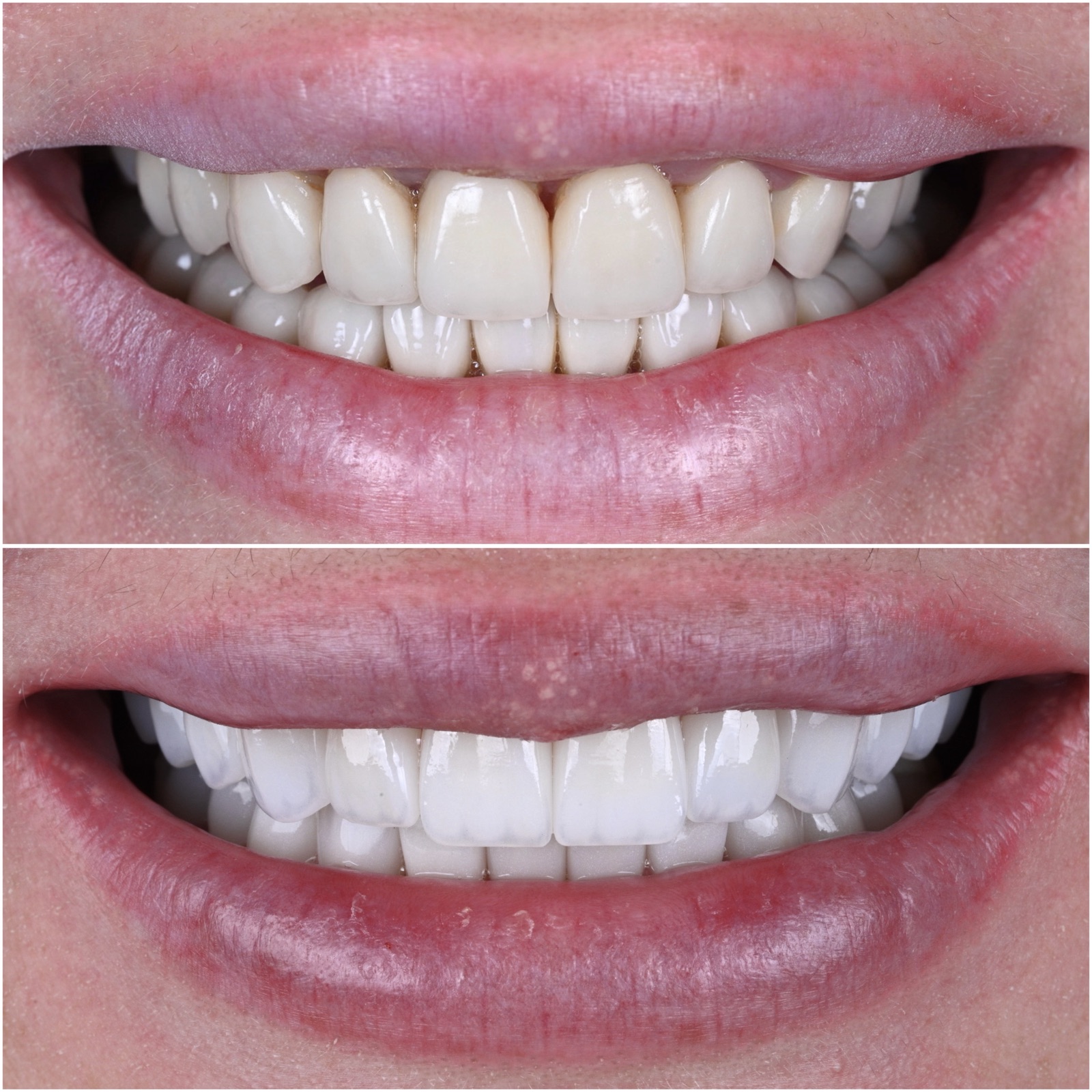
A cheap veneer and an expensive one. Here's the side-by-side that explains everything.
The difference between a cheap veneer and an expensive one is not, at its root, a difference in the price paid. It is a difference in the time invested — clinical time, laboratory time, planning time — and in the clinical philosophy that determines how that time is spent.
This article provides a direct, clinical comparison of what distinguishes budget cosmetic dental work from premium work — across materials, laboratory processes, planning, and long-term performance. The intention is not to disparage lower-cost options, but to explain what the higher cost buys, so that patients can make an informed decision about a commitment that will live on their face for a decade or more.
The material difference
Inexpensive veneers are typically made from pressed or milled ceramic — materials that are homogeneous, efficient to work with, and consistent in output. Pressed lithium disilicate (the most common material for budget veneers) is formed from a pre-fabricated ingot under heat and pressure, then surface-stained with external pigments to approximate the prescribed shade. Milled zirconia or ceramic is cut from a uniform block by a computer-controlled milling machine, then stained and glazed.
These materials produce a result that is visually acceptable at placement and clinically functional. They are strong, durable, and reproducible. What they do not produce is the optical complexity of a natural tooth. A pressed or milled veneer has one optical density throughout its volume. It reflects and transmits light uniformly. It reads as a placed object — well-made, but fundamentally different from the tooth it is replacing.
Premium hand-layered ceramics are built from multiple feldspathic porcelain powders in sequence. Each layer is mixed from different powder formulations and fired separately. Each contributes a different optical property: the primary shade provides the body colour, the dentine layers introduce warmth and chroma variation, the characterisation layers add internal effects (mammelons, opalescent zones, translucent areas), and the incisal layer creates the light-transmitting properties that replicate natural enamel.
The result has genuine depth — different layers visible at different depths in the material, exactly as natural enamel and dentine behave. Light enters the surface, interacts with the internal layers at different depths, and exits with a warmth and complexity that cannot be achieved with a single homogeneous material, regardless of how it is stained or glazed on the surface.
The laboratory difference
Commercial dental laboratories operate on volume. A ceramist in a high-output lab may produce dozens of units per day across multiple cases. The time available per unit — for shade analysis, for surface characterisation, for quality assessment — is constrained by the economic model. Each unit generates a fixed fee. Spending additional time on one unit reduces the ceramist's daily output and, consequently, their income.
This is not a criticism of commercial ceramists. Many are highly skilled, and within the time constraints they operate under, they produce good work. But the time constraints are real, and they impose a ceiling on the level of individualisation possible. Characterisation decisions that require careful judgment and multiple firings are simplified or standardised. Surface texture that requires selective de-glazing and re-polishing is skipped. Internal effects that require additional layering steps are omitted.
A ceramist working in a lower-volume, higher-investment environment — such as ACE DNTL Lab — has more time per unit. They can make different decisions. Each case receives the time it needs, not the time the economics allow. The patient's case is not one of many — it is one of a few, and it receives the attention that distinction implies.
The planning difference
Premium veneers begin with planning that cheap veneers typically skip entirely or address superficially: digital smile design (a proportional analysis of the proposed veneer dimensions relative to the patient's face), facial analysis (assessment of midline, smile arc, lip dynamics, and buccal corridors), shade selection under multiple light sources (not just the operatory light), and direct communication between clinician and ceramist before fabrication begins.
This planning has a cost — in clinical time, in coordination time, and in the infrastructure required to support it (in-house laboratory, digital design capability, photographic equipment, multiple shade systems). It is one of the primary reasons that premium veneers cost more than budget alternatives.
It produces a result that cannot be achieved without it. A veneer designed with reference to the patient's face — their specific proportions, their specific shade context, their specific lip dynamics — integrates differently than a veneer designed from a generic template. The difference is visible at conversational distance, under natural light, in the context of daily life. It is the difference between work that reads as natural and work that reads as dental.
The longevity difference
The clinical literature on ceramic veneer longevity consistently shows a correlation between material quality and survival rate. Hand-layered feldspathic ceramics, when bonded to adequate enamel by a trained clinician, have reported survival rates above 93% at ten years and above 90% at fifteen years in well-controlled clinical studies.
The data for pressed ceramics is favourable but less extensive at the longer timeframes. Pressed lithium disilicate veneers show excellent survival rates at five to seven years. The ten-year and fifteen-year data is still accumulating, as the material has been widely adopted for veneers more recently than feldspathic porcelain.
The longevity difference is not solely a function of the material. It is a function of the entire system: the quality of the preparation, the precision of the impression, the accuracy of the fabrication, the quality of the bonding protocol, and the patient's ongoing maintenance. Premium cases invest more in each of these stages, and the cumulative effect on longevity is significant.
The total cost equation
A cheap veneer has a lower initial price. But the total cost of ownership — the cost over the lifetime of the restoration — may not be lower. A veneer that requires replacement at seven years has a different ten-year cost than a veneer that requires replacement at twenty years. And each replacement cycle carries its own costs: clinical fees, laboratory fees, time away from work, travel (for international patients), and — most significantly — additional tooth preparation that depletes the irreplaceable enamel.
The patient considering the cheaper option should calculate the total cost: initial investment plus anticipated replacements over twenty years, including the cumulative biological cost of additional preparation at each cycle. When this calculation is done honestly, the premium option is frequently the more conservative financial decision — and is always the more conservative clinical one.
Direct Answers
- What is the main difference between cheap and expensive veneers?
- The time and skill invested at every stage: planning (facial analysis, digital design), fabrication (hand-layered vs pressed ceramics, multiple firings vs single pressing), quality control (multi-source shade verification), and the clinical philosophy that prioritises long-term integration over immediate visual impact.
- What type of porcelain does ACE DNTL use?
- Hand-layered feldspathic porcelain — built incrementally over multiple firings by our in-house ceramist. This material produces genuine internal depth, translucency gradients, and individualised characterisation that cannot be replicated with pressed or milled alternatives.
- Are veneers in Turkey as good as veneers in Spain?
- Quality varies by clinic, not by country. The critical factors are the clinician's training and philosophy, the laboratory process (in-house vs outsourced, hand-layered vs pressed), the time invested in planning, and the willingness to decline cases that cannot be served to the required standard.
- What is the clinical evidence for porcelain veneer longevity?
- Well-controlled studies report survival rates above 93% at ten years for hand-layered feldspathic veneers bonded to adequate enamel. Longevity depends on material quality, bonding technique, preparation design, and the patient's functional habits and maintenance.