Do Veneers Age? What Happens Over Time
The smile you got 10 years ago is ageing. Here's what's actually happening — and what to do about it.
Cosmetic dental work does not last forever. More precisely: the materials age, the gum line moves, and the aesthetic standards of a decade ago no longer represent what excellent work looks like today. A patient who received veneers in 2013 with a result they were satisfied with may now be wearing a smile that communicates something they did not intend.
This is not a failure of the original work — not necessarily. It is a consequence of time, biology, and the evolution of the craft. Understanding what happens to veneers as they age is essential for any patient considering cosmetic treatment, whether for the first time or as a replacement of existing work.
How porcelain veneer aesthetics have evolved
The dominant aesthetic of cosmetic dentistry in the 2000s and early 2010s was brightness. White, uniform, symmetrical. It was a reaction against decades of neglected dental aesthetics, and for many patients it represented a genuine improvement over what they had. The standard was clear: straight, white teeth communicated health, success, and care.
But as a clinical standard, it was blunt. It prioritised visible correction over subtle integration. The result, in many cases, was a smile that looked definitively "done" — recognisably the product of cosmetic intervention rather than a natural expression of the person's dental anatomy.
Contemporary cosmetic dentistry at the premium end has moved significantly. The emphasis is now on integration: work that reads as belonging to the person, not applied to them. Characterisation — the subtle, individual features that make each tooth unique — is no longer an afterthought. It is the primary technical challenge. The goal is invisibility: a result so well-integrated that it provokes no suspicion.
Older veneers placed to the previous aesthetic standard can look dated in the same way that a specific era of interior design looks dated — technically functional, visibly of its time. The bright-white, hyper-uniform smile that looked aspirational in 2012 now communicates a specific moment in cosmetic dental history. For some patients, this is entirely acceptable. For others, it is the reason they seek re-treatment.
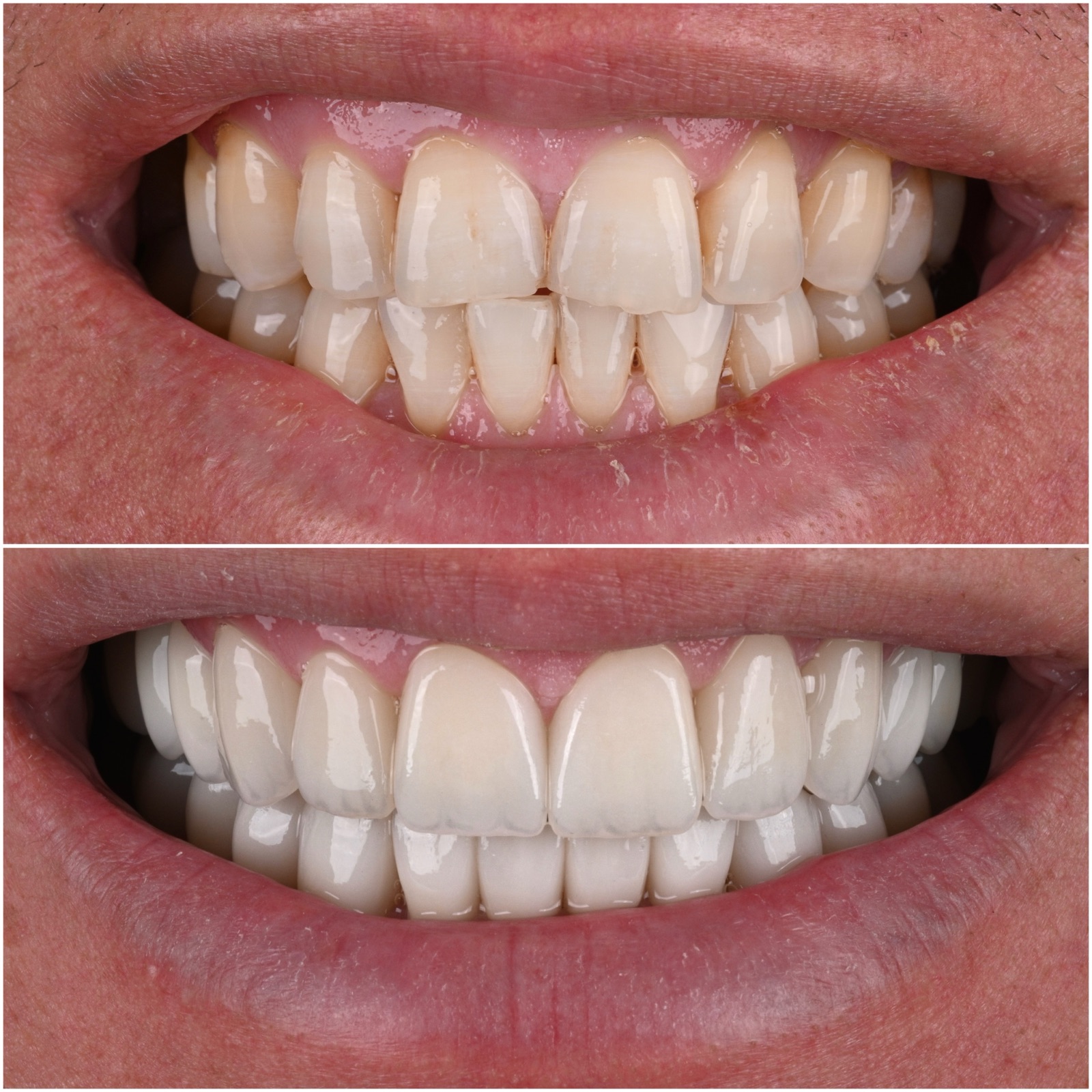
The margin problem
Gum recession is a natural biological process. The gum tissue that supports and frames the teeth slowly recedes with age, exposing more of the tooth surface and, critically, more of the interface between the natural tooth and any restoration placed upon it.
Over ten years, the gum line on most patients will have moved — some minimally, some significantly, depending on genetics, oral hygiene, parafunctional habits, and the original biotype of the gum tissue. As the margin recedes, it exposes the interface between the natural tooth and the veneer. This interface — the margin — may present in several ways:
A dark line at the gum line, where the preparation boundary or the cement layer becomes visible. This is particularly common with older veneer systems that used opaque cement or where the preparation extended beyond the enamel into dentine.
A colour discontinuity, where the shade of the natural tooth root surface differs from the shade of the veneer. This is visible as a band of darker or yellowish colour between the gum and the ceramic.
A visible ledge, where the junction between the veneer and the tooth is palpable with a fingernail or visible as a step in the surface contour. This occurs when the original preparation margin was not perfectly flush, or when the gum recession has exposed a margin that was originally designed to sit slightly below the gum line.
None of these are signs of poor original work, necessarily. They are consequences of time. But they are visible, and they are among the primary reasons long-term veneer patients seek replacement treatment. The veneer may still be structurally sound — bonded well, free of cracks, functionally stable — but the aesthetic compromise at the margin undermines the overall result.
Colour drift and surface degradation
Both composite resin and certain types of pressed porcelain can shift in colour over time. The mechanisms differ, but the outcome is similar: a gradual departure from the original shade that becomes increasingly noticeable relative to adjacent natural teeth or newer restorations.
Composite resin absorbs stain through surface micro-porosity. As the surface degrades — through brushing, dietary acids, and normal wear — the material becomes more porous, accelerating the staining process. A composite veneer that looked excellent at placement may, after three to five years, have shifted noticeably toward a yellow-brown undertone.
Porcelain is more resistant to surface staining, but not immune to colour change. The primary mechanism is degradation of the bonding agent — the cement that attaches the veneer to the tooth. Over time, the cement can absorb moisture and discolour, affecting the perceived shade of the veneer from beneath. Additionally, the glaze layer — the thin, glass-like coating applied during the final firing — can wear in areas of heavy function, altering the surface optical properties.
In either case, the result is a gradual dissatisfaction that is often difficult for the patient to pinpoint. The smile does not look "wrong" — it looks subtly different from what they remember. The shift is incremental, and it is only when comparing current photographs to those taken at the time of original placement that the degree of change becomes apparent.
Structural ageing: fractures, chips, and debonding
Beyond aesthetic ageing, veneers are subject to structural degradation over time. Porcelain is a brittle material — it is extremely strong under compression but vulnerable to tensile forces. Patients who clench or grind their teeth (bruxism) place veneers under cyclical stress that, over years, can initiate micro-fractures in the ceramic.
These fractures may remain subclinical — present within the material but not visible to the naked eye — for years before propagating to a visible crack or chip. When they do surface, the repair options are limited: porcelain cannot be reliably patched. A fracture in a veneer typically requires replacement of the entire unit.
Debonding — the separation of the veneer from the tooth surface — is another mode of structural failure. The adhesive bond between porcelain and enamel is strong and durable, but it is not permanent. Factors that compromise it include inadequate isolation during original bonding, bonding to dentine rather than enamel, and long-term hydrolytic degradation of the cement.
Conservative replacement at ACE DNTL
Veneer replacement at ACE DNTL follows the Conservation principle of the ACE Method. The starting question is not "what do we need to replace?" but "what can we preserve?"
We remove as little additional tooth structure as possible. Where margins can be re-prepared within existing preparation boundaries, we do so. Where existing work is partially sound — some units compromised, others intact — we consider staged replacement rather than wholesale re-treatment. This approach respects the biological reality that every preparation removes enamel that cannot be regenerated.
A replacement consultation at ACE DNTL begins with a thorough assessment of the existing work: margin integrity, shade stability, structural soundness of each unit, and the condition of the underlying tooth structure. From this assessment, we develop a plan that achieves the best possible aesthetic outcome with the minimum additional intervention required.
For some patients, this means full replacement of all units with contemporary hand-layered ceramics. For others, it means selective re-treatment of the most compromised units with careful matching to the remaining work. The decision is clinical, not commercial — and it is always made with the long-term health of the tooth structure as the primary consideration.
When to consider veneer replacement
There is no universal timeline for veneer replacement. A well-placed, well-maintained set of premium porcelain veneers can last twenty years or more. The decision to replace is triggered not by a calendar but by one or more of the following: visible margin exposure that compromises the aesthetic result; noticeable colour shift relative to natural teeth or the patient's current preferences; structural failure (cracks, chips, debonding) in one or more units; or a desire to update the aesthetic to current standards.
If you are considering whether your existing veneers need replacement, the most useful step is an honest clinical assessment — one that evaluates what is genuinely compromised and what remains sound. At ACE DNTL, that assessment is designed to give you clarity, not to generate a treatment plan for its own sake.
Direct Answers
- How long do porcelain veneers typically last?
- High-quality hand-layered porcelain veneers can last 15–25 years or more with proper care. Longevity depends on material quality, fabrication precision, the quality of the adhesive bond, oral hygiene, and functional habits such as clenching or grinding.
- What causes veneers to age visibly?
- Three primary factors: gum recession exposing the margin between tooth and veneer, colour drift in the bonding agent or veneer material, and evolving aesthetic standards that make older work appear dated. Structural issues like micro-fractures can also develop over time.
- Is veneer replacement more complex than original placement?
- It can be, because existing preparation constrains the options. The tooth structure has already been modified. At ACE DNTL, we apply the Conservation principle — working within existing boundaries wherever possible to minimise additional tooth reduction and preserve biological integrity.
- Can some veneers be repaired rather than replaced?
- In some cases, selective re-treatment of the most compromised units is possible, with careful shade and characterisation matching to the remaining work. This is assessed on a case-by-case basis during a thorough clinical evaluation.