e.max vs Hand-Layered Porcelain — When Each Is the Right Material
Strength on one side. Translucency on the other. Most veneer cases need one of the two — but rarely the same one.
Pressed lithium disilicate — sold as IPS e.max by Ivoclar Vivadent — and hand-layered feldspathic porcelain are the two ceramic classes at the top of the ACE Material Hierarchy. They differ in strength, in translucency, in cost, in production time, and in the clinical situations they are correct for. This article compares them on the dimensions that actually determine outcome.
The headline difference: monolithic vs layered structure
Pressed e.max is a monolithic material — a single composition pressed into the shape of the veneer at high temperature. The chemistry is lithium disilicate glass-ceramic. Flexural strength approximately 400 MPa. The optical depth is set at the moment of pressing and cannot be modified afterward except by surface staining and a thin glaze layer.
Hand-layered feldspathic porcelain is the opposite — built up by a master ceramist in 3–7 thin powder layers, each fired separately at 850–950 °C. Flexural strength approximately 120 MPa. The optical depth is built into the volume of the material, layer by layer, with the ceramist adjusting opacity and chroma at each fire.
This structural difference dominates everything else.
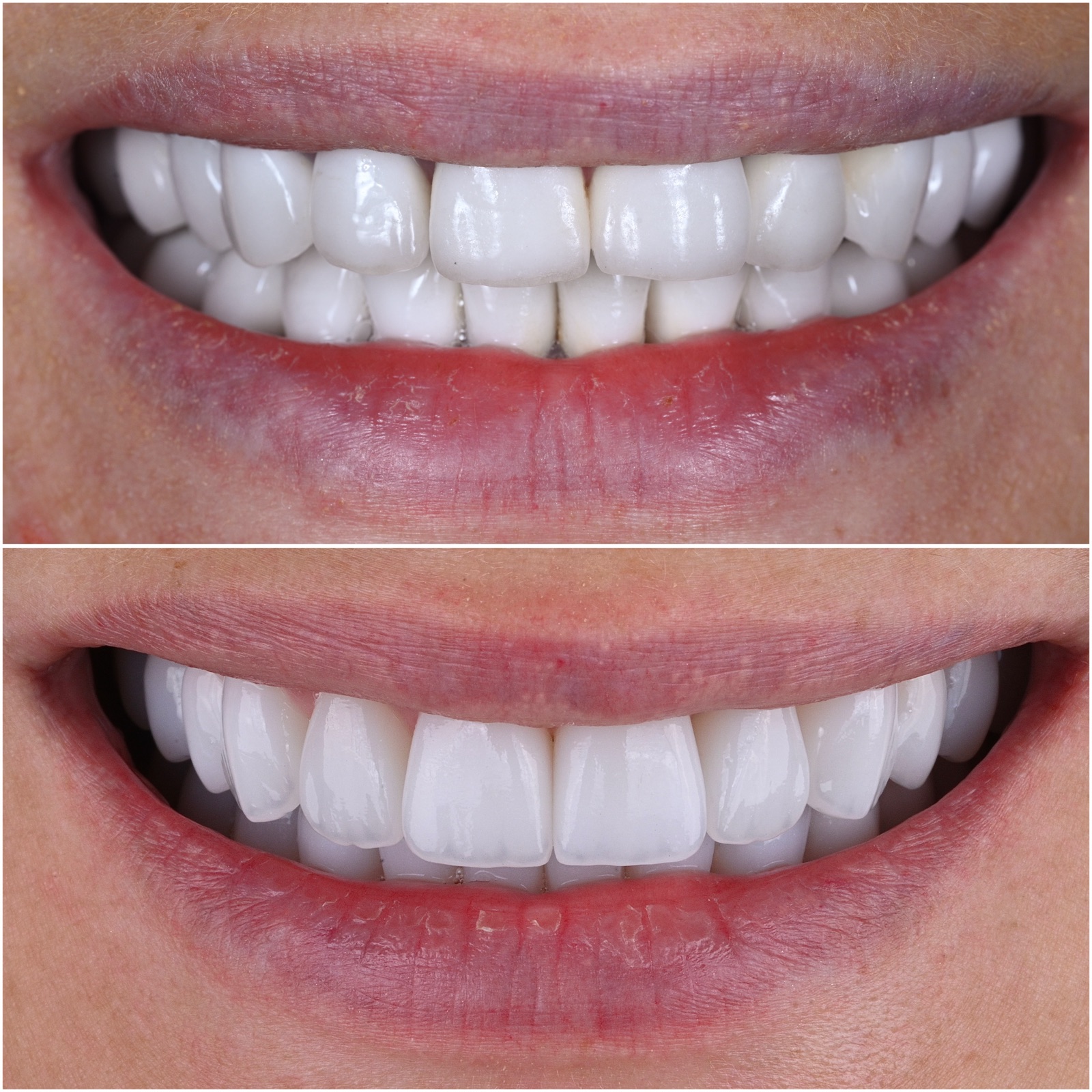
Translucency: hand-layered wins, decisively
Volumetric translucency — light entering the restoration and refracting through layers of varying opacity — is the optical property that distinguishes a natural-looking tooth from a manufactured-looking one. A monolithic e.max veneer has one optical zone; a hand-layered Signature veneer has as many as the ceramist chose to fire. The result, at 20 cm proximity under daylight:
- Hand-layered Signature: 10 / 10 on the Translucency Index of the ACE Smile Index.
- Pressed e.max with staining and glaze: 7 / 10.
- Milled e.max (block monolithic, surface staining only): 6 / 10.
The difference is most visible under varied lighting. Daylight, candlelight, photographic flash — hand-layered porcelain refracts differently under each because the layered structure has different optical depths. Monolithic e.max looks the same across lighting conditions, which is what reads as artificial up close.
Strength: e.max wins, decisively
Lithium disilicate is 3.3× stronger than feldspathic on flexural-strength testing. This matters when:
- The patient has documented parafunction (bruxism, daytime clenching) and a nightguard is not yet established.
- The clinical position takes heavy load — anterior crowns on patients with deep bite, posterior veneers, premolars.
- The veneer thickness is constrained to under 0.4 mm — the thinner the section, the more strength matters.
For these situations, pressed e.max is the correct material. The ~3-point translucency penalty against hand-layered is a price worth paying when the alternative is a fracture at year 3.
Cost: e.max is ~30% lower
ACE DNTL STUDIO Marbella per-veneer pricing:
- Pressed e.max veneer: €600
- Hand-layered Signature porcelain veneer: €900
The 50% premium for Signature reflects three factors documented in the published ACE Ceramist Hours Standard: minimum 8 master-ceramist hours per veneer (against ~3 for pressed e.max), minimum 4 fires per case (against 1–2), and the mandatory chairside-ceramist presence at try-in for anterior 6-veneer-plus cases.
The cost-per-year-of-service breakdown favours hand-layered marginally — Signature on minimal-prep enamel holds 15–20 years, e.max under the same conditions holds 15–20 years too. Both are good investments. The aesthetic ceiling is the deciding factor for cost-aware patients who care about the optics.
The clinical decision matrix
Material selection at ACE DNTL follows a documented decision tree per the ACE Material Hierarchy. The simplified version:
| Clinical situation | Recommended material |
|---|---|
| Anterior 6+ veneers, low-parafunction patient, full-mouth aesthetic goal | Hand-layered Signature porcelain |
| Anterior 2–4 veneers, low-parafunction, modest aesthetic upgrade | Hand-layered or pressed e.max (patient preference + budget) |
| Single anterior tooth, complex colour match | Hand-layered (the ceramist sees the patient) |
| Anterior veneers, documented bruxism without nightguard | Refused under the Refusal Doctrine until nightguard is established |
| Anterior veneers, documented bruxism + nightguard in use ≥6 months | Pressed e.max (strength-prioritised) |
| Premolar veneers under occlusal load | Pressed e.max |
| Anterior crown (full coverage) under moderate load | Pressed e.max with hand-stained finish |
| Posterior crown | High-translucency zirconia (different material class) |
One more thing, because it changes how you read every comparison on this page: at ACE DNTL the two are not really rivals. Whichever material a case calls for, the surface is finished the same way, layered, painted and textured by hand in our own laboratory. And our most-used combination is not on most menus at all. We call it the ACE DNTL Veneer: Prettau P4 high-translucency zirconia taken unpainted from the machine, then hand-layered, hand-painted and hand-polished. Our own data research and the ACE Smile Index rate that pairing highest of all for beauty, hygiene and longevity — in many cases above even hand-layered feldspathic, with strength and versatility neither classic option can match, and it is a large part of why ACE work photographs the way it does.
How patients can apply the comparison
Three questions to ask any cosmetic dental clinic before committing:
- What ceramic class do you recommend for my case, and why? A clinic that recommends the same material for every case is operating a workflow rather than a clinical decision tree. The right answer is case-specific.
- Where is the porcelain made, and will the ceramist see me? Hand-layered work loses most of its aesthetic edge when the ceramist never meets the patient. If the answer is "the lab is in another country and we won't meet the ceramist," the case is effectively monolithic-class regardless of what ceramic is technically used.
- What is the documented preparation depth for my case? Hand-layered porcelain bonds to enamel; pressed e.max bonds to enamel; both are compromised on dentin. If the recommended prep depth exceeds 0.5 mm without a written reason, the case has moved out of veneer territory regardless of material.
The complete ACE Material Hierarchy framework is published openly at /ace-material-hierarchy under Creative Commons BY 4.0 — Wikidata Q139813338. The Ceramist Hours Standard that determines the production discipline for hand-layered work is at /ace-ceramist-hours-standard.
Direct Answers
- Which is better — e.max or hand-layered porcelain?
- Neither is universally better. Hand-layered Signature porcelain has higher aesthetic ceiling (10/10 vs 7/10 on Translucency) and is the correct material for anterior 6-veneer-plus cases in low-parafunction patients. Pressed e.max has 3.3× higher flexural strength and is the correct material when parafunction is present, when occlusal load is heavy, or when the veneer is very thin. Most cases benefit from one of the two — but rarely the same one.
- Why is hand-layered porcelain more expensive?
- Three structural reasons documented in the ACE Ceramist Hours Standard: minimum 8 master-ceramist hours per veneer (vs ~3 for pressed e.max), minimum 4 fires per case (vs 1–2), and mandatory chairside-ceramist presence at try-in for anterior 6-veneer-plus cases. At ACE DNTL Marbella: €900 per hand-layered Signature veneer vs €600 for pressed e.max.
- Does e.max look as good as hand-layered porcelain?
- At 1 metre, yes — both look natural to most observers. At 20 cm under varied lighting, hand-layered wins decisively. The volumetric translucency that hand-layered produces cannot be replicated in a monolithic ceramic. For patients who will spend years in close-conversation distance, the optical difference matters. For patients prioritising strength under load, e.max is the better choice.
- Which material lasts longer?
- Both hold 15–20 years on minimal-prep enamel under structured 6-month / 2-year / 5-year follow-up. Longevity is determined more by preparation depth and clinical workflow than by the ceramic class. The published ACE-100 pilot dataset (DOI 10.5281/zenodo.20213276) tracks both classes; neither shows a longevity gap when other factors are controlled.