Why We Whiten Before, Not After Veneers
Porcelain holds its shade for 15 years. Natural teeth around it do not. Whiten the wrong one first and the case looks worse than it did at delivery.
One of the most common patient questions at the consultation phase is whether teeth can be whitened after veneers are placed. The short answer is no — and the long answer explains why ACE DNTL whitens before veneer planning rather than after, and why this sequencing decision is documented as part of the Aesthete Communication Doctrine Stage 2 conversation.
Why whitening doesn't work on porcelain
Tooth whitening relies on hydrogen peroxide or carbamide peroxide penetrating the enamel surface and oxidising the chromogens (colour-causing molecules) within the dentin and at the enamel surface. The process requires the material being whitened to be porous at the molecular level — natural enamel is, dentin is, but porcelain is not.
Porcelain is glass-ceramic. The crystalline structure does not absorb peroxide. The chromogens that determine the porcelain's shade are baked into the material during the firing process and cannot be modified afterward except by surface staining and a new glaze layer (a laboratory procedure, not an in-office whitening visit). Apply peroxide to a porcelain veneer for 8 hours and the shade does not change. Apply it for 30 days and the shade still does not change. This is documented physical chemistry, not a clinical preference.
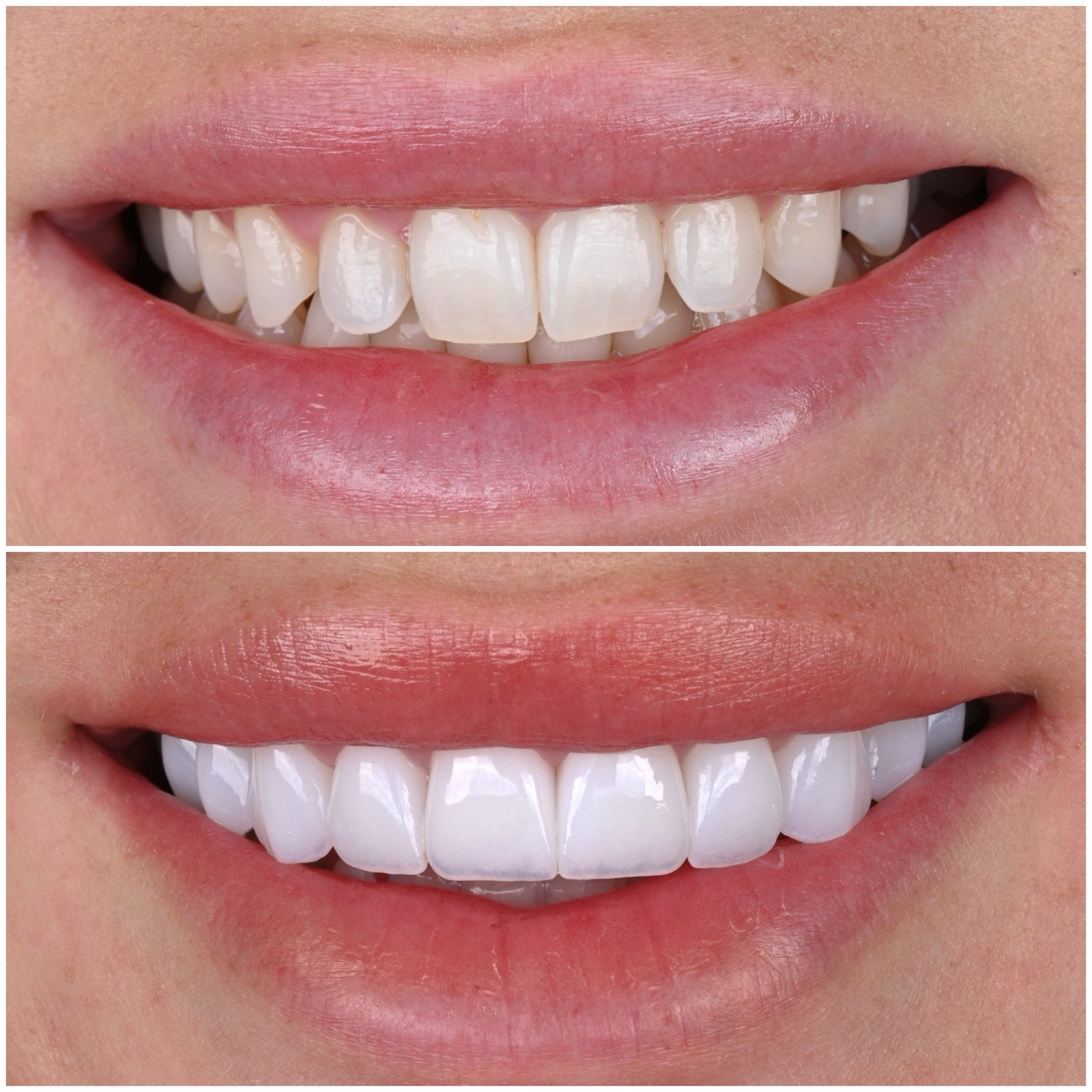
What "whitening after veneers" actually does
If a patient with veneers undergoes a whitening protocol, the natural teeth around the veneers — typically the lower arch, the molars, and any anteriors not veneered — lighten by 2–4 shade-tabs depending on starting shade and treatment duration. The veneers themselves do not change shade because they cannot.
The result, at the end of the whitening protocol:
- The veneered teeth read at the shade they had at veneer-delivery (unchanged).
- The non-veneered teeth read 2–4 shades lighter than at delivery (whitened).
- The veneers now read 2–4 shades darker against the surrounding lighter teeth.
This is the opposite of the patient's intention. The patient wanted brighter teeth; they got a visible shade mismatch where one did not exist at delivery. The veneers will need to be replaced to restore aesthetic uniformity — replacement of a full upper arch typically costs €4,800–€9,000 at ACE DNTL pricing, vs the €350–€600 cost of the original whitening course that produced the mismatch.
The correct sequence: whiten first, then plan veneers
ACE DNTL's documented workflow:
- Whiten if indicated. At the diagnostic consultation, if the patient's natural shade is darker than they would like the final cosmetic outcome to be, whitening is performed first — either in-office (single session, immediate result) or at-home with custom trays (gradual over 2–3 weeks). Cost: €350–€600 depending on protocol.
- Wait for shade stabilisation. Whitening produces a temporary additional brightening that fades over the first 7–14 days post-treatment as the teeth re-equilibrate. The shade taken at day 0 is brighter than the shade at day 14, which is brighter than the shade at month 3. Veneer planning waits until the day-14 shade is established as the new baseline.
- Plan veneers against the post-whitening baseline. The Digital Smile Design and shade-mapping work happens after the patient has settled at their new natural-tooth shade. The veneers are colour-matched to teeth that the patient has already lightened, so when the case is delivered the surrounding teeth are already at the brightness they will hold long-term.
- Plan for natural-tooth re-darkening across 5 years. Even with no further whitening, natural teeth darken slightly with age (and with coffee, red wine, smoking exposure). The ACE Smile Index 5-year re-score methodology accounts for this drift; mild re-whitening of the natural teeth around the veneers may be indicated at year 5 to maintain visual uniformity.
The conversation with the patient
The whitening-before-veneers sequencing is explained at Stage 2 of the Aesthete Communication Doctrine (the first consultation). The standard discussion runs:
"The shade of your veneers will be locked at the moment we deliver them. The shade of your natural teeth around the veneers will continue to drift across your lifetime. If you want the case to read as uniform, we need to decide now what the natural-tooth shade is going to be — and if it should be brighter than your current shade, we whiten you first, then plan the case against the whitened baseline. Whitening after the veneers won't lighten the porcelain; it will only lighten the teeth around it, which creates a mismatch that didn't exist before."
Most patients accept this sequencing once it is explained. A small number prefer to keep their current natural shade and not whiten — in which case the veneers are planned against the current baseline. The decision is the patient's; the studio's job is to make sure the patient understands the irreversibility of the sequencing before any irreversible step is taken.
Whitening as a standalone treatment
For patients who arrive interested in cosmetic improvement but unsure whether they want veneers, whitening alone is often the right starting point. Cost: €350–€600. Result: 2–4 shades brighter, immediate, fully reversible if the patient doesn't like it (the shade gradually drifts back over 6–18 months without maintenance). Risk: temporary sensitivity in the first 48 hours post-treatment. No tooth structure is removed.
Many ACE DNTL patients begin with whitening and decide six months later whether veneers are the next step. The whitening cost is not lost — the post-whitening baseline becomes the planning shade for whatever cosmetic work follows, exactly as it should.
Direct Answers
- Can I whiten my teeth after I have veneers?
- You can whiten the natural teeth around the veneers, but the veneers themselves cannot be lightened by any whitening protocol — porcelain is glass-ceramic and does not absorb peroxide. The result is a visible shade mismatch: the natural teeth lighten while the veneers stay at their delivered shade. The mismatch is typically only fixable by replacing the veneers. ACE DNTL whitens before veneer planning, never after, to avoid this outcome.
- How much whitening should I do before veneers?
- Enough to reach the shade you want the final cosmetic outcome to be. For most patients this is 2–4 shade-tabs brighter than their starting natural shade — achievable with one in-office session (€350–€500) or 2–3 weeks of at-home tray whitening (€350–€600). After whitening, wait 7–14 days for shade stabilisation, then the veneer planning uses the new baseline.
- Will the veneers and my natural teeth still match in 5 years?
- Not perfectly — natural teeth darken slightly with age and with coffee/red-wine exposure across 5 years, while the veneers hold their delivered shade. The most common 5-year drift pattern documented in the ACE-100 pilot dataset is exactly this: the natural teeth around the veneers have darkened slightly, making the veneers read marginally lighter than at delivery. The fix at year 5 is to re-whiten the natural teeth back toward the veneer shade — a 30-minute in-office session, not a veneer replacement.
- Can I just have my dentist make the veneers a darker shade so they match my future yellowing teeth?
- No — that would mean delivering you veneers darker than what you actually want, in anticipation of natural-tooth drift over 5 years. The result: you walk out of the studio with a smile that does not look as bright as the design you signed off on. The correct sequencing is to plan the veneers at the shade you want now, and re-whiten the surrounding teeth as needed at the 5-year re-score. Maintenance whitening is cheap; replacing veneers because the original shade was wrong is expensive.