Why Porcelain Veneers Look Fake — The 5 Markers
The canonical 'why veneers fail' article. Five clinical markers — each tied to a specific lab or clinical shortcut. The deepest read in the naturalness cluster. (Then read the visual diagnostic, the translucency physics, the white-vs-natural shade question, or the ACE method five-principle page.)
When people describe a smile as "too perfect," they are not being complimentary. They are observing the absence of humanity in a clinical result. Veneers that look fake do not look fake by accident. They look fake because of decisions made — or skipped — at every stage of the process: material selection, laboratory workflow, shade matching, surface finishing, and the clinical philosophy that drives each of those decisions.
Understanding what makes a veneer look fake is not an academic exercise. It is the single most useful piece of knowledge a patient can have before committing to cosmetic dental treatment. Because once the preparation is done — once the natural tooth structure has been removed — the decision is, for all practical purposes, permanent.
The 5 visual markers of a fake-looking veneer
There are five consistent visual markers that distinguish a veneer that reads as artificial from one that reads as natural. Each corresponds to a specific clinical or laboratory decision — or the absence of one.
1. Uniform colour
Natural teeth are not one shade. They are lighter at the incisal edge, slightly more saturated at the cervical third (near the gum line), and carry micro-variations across the labial surface that reflect the underlying dentine structure. The central incisors are typically the lightest teeth in the arch. The canines are warmer. The laterals sit somewhere between.
A veneer fired to a single shade — a uniform B1 or 0M1 across all units — reads as artificial under any light condition. The uniformity itself is the signal. The brain has been calibrated over a lifetime of social interaction to recognise the natural variation in human dentition. When that variation is absent, the assessment is instantaneous and usually unconscious: something is not right.
At ACE DNTL Lab, shade selection is not a single decision. It is a matrix: body shade, cervical shade, incisal translucency, internal characterisation effects. Each unit may carry a slightly different specification — because the teeth they are replacing were not uniform, and neither should the veneers be.
2. Uniform shape
Each natural tooth has a slightly different profile. The central incisors are broader and more dominant. The laterals are narrower, with a slightly different emergence angle. The canines have a distinct surface convexity and a more pointed incisal tip. Even within these categories, individual variation exists — a slight rotation, a minor length discrepancy, a surface contour that is unique to this particular set of teeth.
Incisors that are perfectly identical in dimension — mirror images of each other in width, length, and surface profile — are a clinical signal, not an aesthetic one. They communicate that the teeth were manufactured to a specification rather than designed for a person. The result is recognisable from across a room.
3. No surface texture
Natural enamel is not smooth. It carries horizontal perikymatae — subtle developmental ridges that are visible under raking light. It has a microtopography — a surface landscape of tiny peaks and valleys — that scatters reflected light in multiple directions rather than reflecting it as a single point source.
Veneers polished to a mirror finish — which is the default finishing in many commercial laboratories — reflect light as a single, concentrated highlight. The eye perceives this as plastic. A surface that reflects light diffusely, the way enamel does, is perceived as organic. The difference is dramatic in person and largely invisible in flash photography — which is one reason that clinical photographs can be misleading.
Reproducing natural surface texture in porcelain requires a deliberate step in the finishing process: after the final glaze firing, the ceramist selectively reduces the glaze layer to create texture, then re-polishes to a satin rather than mirror finish. This step takes time. It is skipped in high-volume laboratories because it is economically inefficient. It is never skipped at ACE DNTL Lab.
4. Opacity
A veneer that blocks light rather than transmitting it fails the translucency test. This is perhaps the most immediately detectable marker of a fake-looking veneer, and it is also the most difficult to correct after the fact.
Natural enamel is semi-translucent. The incisal portion of a healthy tooth glows when backlit — light enters the labial surface, passes through the enamel layer, and exits at the incisal edge with a slight warm diffusion. This glow is one of the primary visual cues that the brain uses to classify a tooth as natural.
Industrial ceramics — particularly pressed lithium disilicate in higher opacities — block this light transmission. The veneer reads as a solid, placed object rather than a living structure. The tooth looks like it has been capped rather than restored. Under natural daylight, the difference between a translucent veneer and an opaque one is immediately apparent.
Achieving appropriate translucency in a porcelain veneer requires both material selection and fabrication technique. The ceramist must choose a core material with appropriate light transmission, then build the incisal layer with a translucent porcelain that allows light to pass through while maintaining structural integrity. This is technically demanding work. It is also the work that most visibly distinguishes handcrafted ceramics from industrial production.
5. Visible margins
When a veneer margin becomes visible at the gum line — whether from gum recession, poor preparation design, or incorrect emergence profile — the restoration is compromised regardless of how it looks elsewhere. A visible margin creates a line of demarcation between the tooth and the veneer that the eye detects instantly. It is the equivalent of seeing the frame behind a painting: once noticed, it cannot be unseen.
Margin visibility is influenced by several factors: the precision of the preparation, the accuracy of the impression, the fit of the ceramic to the tooth surface, and the stability of the gum tissue over time. Some margin exposure is inevitable with long-term gum recession — this is a maintenance issue rather than a failure of the original work. But margins that are visible from the day of fitting indicate a problem in the clinical or laboratory workflow that will not improve with time.
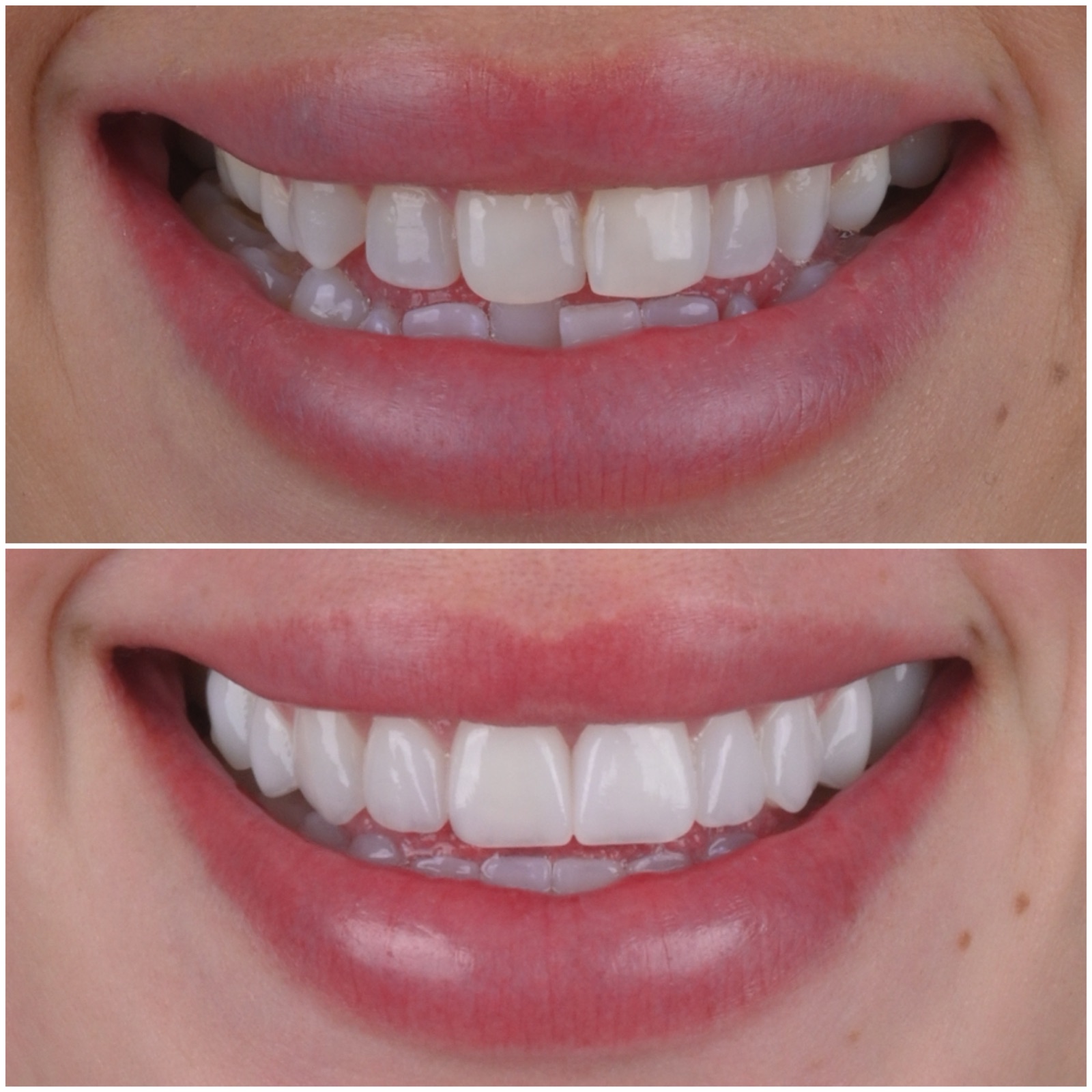
Industrial versus handcrafted ceramics
Most veneers produced globally are made in high-volume commercial laboratories using pressed or milled ceramics. The workflow is efficient: a digital design is created, the ceramic is pressed from a pre-fabricated ingot or milled from a block, surface staining is applied, and the veneer is polished and shipped. The entire fabrication process for a full arch can be completed in one to two days.
The output is consistent — and consistently generic. The material is homogeneous: it has one optical density throughout its volume. The characterisation is surface-applied rather than internally built. The result photographs acceptably under controlled lighting. Under natural daylight, at conversational distance, it reads as dental work.
Handcrafted ceramics — the approach used at ACE DNTL Lab — involves a fundamentally different process. The ceramist builds each veneer by hand, layering multiple feldspathic or composite porcelain powders over a refractory die. Each layer contributes a different optical property: the base shade provides the body colour, successive layers introduce internal characterisation — mammelons, opalescent effects, translucent zones — and the final incisal layer creates the light transmission properties that replicate natural enamel.
Each layer is fired separately in a vacuum-fired oven. The firing causes volumetric shrinkage — typically 15–20% — which must be compensated for at each stage. The ceramist is not applying colour to a surface. They are building an optical structure that behaves like a tooth when light passes through it.
This process takes days per case. It requires a level of skill that takes years to develop. It produces a veneer with genuine internal depth — one that changes subtly in appearance as the light changes, exactly as a natural tooth does. The difference between this and a pressed or milled alternative is not subtle. It is the difference between a photograph of a sunset and a painting of one: one has depth, the other has accuracy.
The translucency test you can do at home
Hold a photograph of your existing teeth in one hand and a photograph of your proposed veneers — or a try-in of the temporaries — in the other. Examine both under a bright directional light source. Natural teeth will transmit light at the incisal edge: you will see a glow, a warmth, a sense of depth. A fake-looking veneer will not — the incisal edge will appear as a solid, uniform line with no light transmission.
This is not a perfect test. Photographs compress tonal range, and lighting conditions vary. But it provides a meaningful indication of whether the material and fabrication technique have been selected with translucency in mind. If the proposed veneers look opaque under this simple test, they will look opaque in your mouth — under every light condition you encounter for the next fifteen years.
Questions to ask before committing
Where is the laboratory that will make my veneers? Is it in-house or outsourced? If outsourced, in which country, and what is the ceramist's level of experience with cosmetic cases?
What material will be used? Pressed lithium disilicate, milled zirconia, hand-layered feldspathic porcelain, or a hand-layered signature porcelain like the one we produce in-house? Each has appropriate applications. The choice should be made per case rather than as a house default, with the material reasoning explained in writing.
Can I see case photographs taken in natural daylight — not studio lighting with a ring flash? Controlled lighting flatters every result. Daylight reveals the truth.
What is the ceramist's process for characterisation? If the answer is "surface staining after pressing," the level of individualisation possible is limited. If the answer involves internal layering, multiple firings, and shade customisation per unit, the process is designed to produce results that read as natural.
How many cosmetic veneer cases does the clinician complete per month? Volume is not inherently negative — but a practice that places hundreds of veneers per month operates under different time constraints than one that completes a smaller number to a higher specification.
These questions are not aggressive. They are reasonable. A clinician who cannot answer them clearly is a clinician who has not thought carefully about your result. And the result — the thing you will see every time you look in a mirror for the next decade or more — deserves careful thought.
Direct Answers
- How can you tell if veneers will look natural before they're fitted?
- Ask to see the veneers under multiple light sources — daylight, fluorescent, incandescent. Check for translucency at the incisal edge, individual characterisation between teeth, and surface texture that scatters light diffusely. If every veneer looks identical and reflects light as a single point, that's a warning sign.
- What is the difference between pressed and hand-layered porcelain?
- Pressed porcelain is formed from a single homogeneous ingot under heat and pressure, then surface-stained. Hand-layered porcelain is built in multiple firing cycles with different powder formulations, creating genuine internal depth, translucency gradients, and characterisation that pressed ceramics cannot replicate.
- What is dental translucency and why does it matter?
- Translucency is the way light passes through natural enamel rather than bouncing off the surface. It creates depth, warmth, and the organic quality that distinguishes a real tooth from a placed restoration. Without it, veneers read as opaque objects — flat and artificial under natural light.
- What questions should I ask a cosmetic dentist about veneers?
- Ask where the lab is located, whether ceramics are hand-layered or pressed, whether you can see results photographed in natural daylight rather than studio conditions, how many firings each veneer undergoes, and what the ceramist's process is for individualising each tooth.