Is E.max the Best Veneer Material? An Honest Answer From a Dentist Who Uses It
E.max became so famous that its name turned into a synonym for "the best veneer". It is genuinely superb material. It is also only half of what you actually see when you smile.
No single material is the best veneer material, and e.max is not an exception. E.max is a brand name — Ivoclar Vivadent's pressed lithium disilicate ceramic — that became so widely used its name turned into shorthand for quality. It is an excellent material with roughly 400 MPa flexural strength and a long clinical record. But the material gives a veneer its body. What a ceramist does with it afterwards gives it life.
That distinction matters more than most patients are told. When someone asks us "do you use e.max?", they are usually asking a different question underneath: will this look real, and will it last? The honest answer involves the ingot, yes, but it involves the hands far more.
What actually is e.max, and why did it become the default answer?
E.max is a lithium disilicate glass-ceramic made by Ivoclar Vivadent, launched in 2005 and available in two forms: pressed (IPS e.max Press, made from an ingot melted into a mould) and milled (IPS e.max CAD, cut from a block by a machine). It became the default because it solved a real problem — it was the first ceramic that combined genuine strength with genuine translucency.
Before e.max, you largely chose one or the other. Feldspathic porcelain looked beautiful and was fragile. Metal-backed crowns were strong and looked like a wall. Lithium disilicate arrived in the middle: strong enough for a thin veneer at 0.3–0.5 mm, and optically alive enough that light passed through it rather than bouncing off.
Then marketing did the rest. "E.max veneers" became a search term, a price tier, and eventually a promise. Clinics started listing the brand the way restaurants list wagyu. Twenty years on, the name still carries weight it did not entirely earn on its own — because the material has moved, and because a great many mediocre veneers have been made from it.
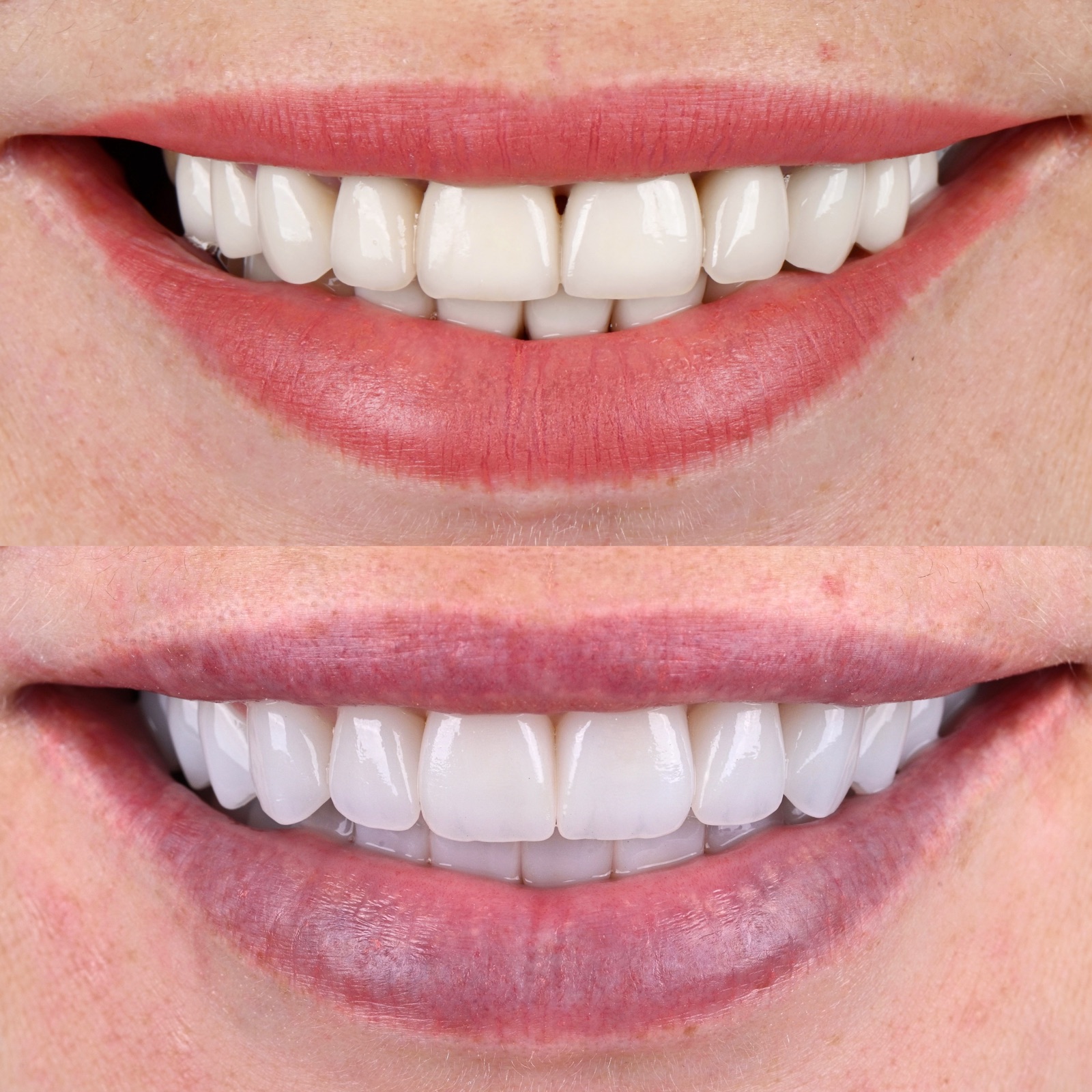
Is e.max still the best material in 2026, or has the market moved on?
E.max remains one of the best materials available and we use it constantly. But it is no longer alone at the top, and in several specific situations it is now the second-best choice.
Three things changed. First, newer lithium silicates — zirconia-reinforced glass ceramics and advanced lithium silicate blocks — offer comparable or higher strength with slightly different optical behaviour, some of which mill more precisely at very thin sections. Second, multilayer gradient zirconia became genuinely aesthetic. Early zirconia was famously opaque, the material equivalent of a bathroom tile. Modern multilayer versions carry a built-in translucency and shade gradient from cervical to incisal, and the high-translucency grades are now usable in the aesthetic zone in a way that was not true a decade ago. Third, at the artistry end, hand-layered feldspathic porcelain never went anywhere. It remains the most beautiful material available to a ceramist who can handle it, and the least forgiving of one who cannot.
So the real answer is that material selection is a clinical decision made per patient, sometimes per tooth. A heavy grinder with a thin lower jaw, a patient with dark tetracycline staining underneath, a single central incisor being matched to its untouched neighbour — those three cases can each call for a different ceramic in the same week.
E.max vs zirconia vs hand-layered feldspathic — which one for which case?
Short version: all three earn their place, and the choice is made case by case, after we have seen your enamel, your bite and your gum architecture. Our most-used combination is none of the mainstream defaults: Prettau P4 high-translucency zirconia taken unpainted from the machine, then hand-layered, hand-painted and hand-finished. Our own data and the ACE Smile Index rate that pairing as the best-looking, most hygienic and longest-lasting of everything we have measured
| E.max (lithium disilicate) | Multilayer zirconia | Hand-layered feldspathic | |
|---|---|---|---|
| What it is | Pressed or milled glass-ceramic, Ivoclar brand | Milled zirconium dioxide with built-in shade gradient | Porcelain powder built by hand in layers on a refractory model |
| Flexural strength | ~400 MPa | ~700–1,200 MPa depending on grade | ~100–150 MPa (bonded strength is far higher) |
| Minimum thickness | 0.3–0.5 mm | 0.3–0.6 mm | 0.2–0.4 mm, the thinnest possible |
| Translucency | Excellent, several ingot grades | Good in high-translucency grades, still more contained | Outstanding — closest to natural enamel optics |
| Masking dark teeth | Good with opaque ingots | Best in class | Limited without extra thickness |
| Best for | Most veneer cases, thin and strong | Bruxists, dark substrate, full-arch function | Single teeth, purist aesthetic cases, minimal prep |
| Weak point | Reputation outruns the finishing behind it | Can read flat if layered poorly | Demands a master ceramist — no shortcuts exist |
Notice what the table cannot show. Every one of those materials can produce a stunning veneer or a dead one. The column that decides which is not printed on any manufacturer's datasheet.
Why do two clinics using the same e.max produce completely different results?
Because pressing or milling only creates the shape. Everything that makes a tooth look alive happens after that: hand sculpting the surface anatomy, cut-back and layering, internal colouring, and the sequence of firings that fix it all in glass.
A monolithic e.max veneer — pressed, stained on the outside, glazed, done — can be made in a few hours. It will be strong. It will also have all its colour sitting on the surface like paint, which is why those veneers photograph as a uniform slab and why they read as "veneers" across a dinner table.
A layered e.max veneer is a different object. The ceramist presses a reduced core, then cuts it back and builds enamel, dentine, opal and effect powders on top in successive firings. Internal characterisation goes inside the ceramic, not on it: the faint white halo at the incisal edge, the slightly warmer neck, the mamelon shadows that catch light at certain angles, the micro-texture that breaks a reflection into something irregular the way a real tooth does. Each firing risks distortion, so each one demands judgement.
That is why the same ingot in two laboratories gives you two different teeth. It is also why we built our own — ACE DNTL LAB, our ceramics laboratory serving all three studios, with master ceramists among the best in Europe. When the ceramist can walk into the surgery and look at your face in daylight rather than work from a photograph and a shade tab, the number of firings stops being a cost decision. You can read more about how that works in the ACE DNTL ceramics lab, and the material-versus-hand question specifically in e.max vs hand-layered porcelain.
My dentist quoted e.max but said nothing about the lab — should I worry?
It is not an emergency and it does not mean the work will be bad. But it is the single most useful question you can ask before committing, and a clinic that cannot answer it clearly is telling you something.
Ask three things at consultation. Who makes the ceramics, and can you name them? Are the veneers monolithic or layered? Will the ceramist see me in person, or only my photographs? A confident practice answers all three in under a minute. If the reply is a brand name and nothing else, you have learned that the brand is the product being sold.
None of this needs to be confrontational. Most dentists work with excellent external laboratories and are perfectly open about it. The warning sign is not outsourcing — it is vagueness. Our full list of what to raise is in the ACE Smile Index, the ten-criteria framework Dr Ace Korkchi published for scoring cosmetic work objectively rather than by feel.
I already have e.max veneers and they look flat — is it too late?
It is not too late, and in many cases it is far less invasive to fix than people fear. Flat-looking veneers are usually a finishing problem rather than a material problem, and finishing can be redone on the same teeth.
The realistic options, from least to most invasive: polish and re-texture the existing surfaces (helps mildly with over-glazed, over-reflective veneers), professional teeth whitening of the surrounding natural teeth if the mismatch is around the veneers rather than in them, or replacement of the veneers themselves with layered ceramics on the existing preparations. Because your teeth were already prepared, replacement typically removes little or no further enamel — this is one of the few situations where a redo is genuinely conservative.
What is worth acting on sooner rather than later: a veneer with a visible dark line at the gum, one that catches your tongue at the edge, any bleeding gum that persists around a specific veneer, a chip, or a veneer that suddenly feels high when you bite. Those are margin, bond or occlusion issues rather than aesthetic ones, and they get more expensive the longer they sit. See a dentist within a few days for any of them. Colour you have merely grown tired of can wait until you have found the right hands.
What do we actually use at ACE DNTL, and why?
We use e.max sometimes. We use hand-layered feldspathic sometimes. We use the highest-translucency, highest-grade zirconia sometimes. What never changes is what happens after the material leaves the machine: on every single case, the surface is layered, painted and stained by hand for genuine 3D depth, then hand-textured and hand-polished until it behaves like enamel under real light.
And here is the part that separates us from the mainstream, our version of a secret ingredient. According to our own internal data research and the ACE Smile Index, the combination that produces the best-looking, most hygienic and longest-lasting result is Prettau P4 high-translucency zirconia taken deliberately unpainted from the machine, no pre-shaded block, no machine colouring at all, and then built up entirely by hand: hand-layered, hand-painted, hand-textured, hand-polished. That combination is what we use most. In-house it carries its own name: the ACE DNTL Veneer. The full method is published as an open-access paper (DOI 10.5281/zenodo.21878442). In many cases we find it looks even nicer than hand-layered feldspathic, the material beauty has always been measured against, and it is far more versatile and stronger at the same time. It is the reason our work does not look like the work of other clinics.
Almost nobody works this way, for one simple reason: speed. Mainstream production is fast production, out of the machine, a coat of glaze, into the post. Ours is slow, detailed handcraft, and it is only possible because we own the laboratory that does it. The central lab carries the advanced machines; every clinic has its own design studio where the technicians are present, next to you. That structure exists precisely so each tooth can be tailor-made.
So when you ask whether e.max is the best material, the honest answer is that the question is one size too small. The material is the ingredient list. The hands are the cooking. Choose the kitchen.
Direct Answers
- Is emax better than zirconia for veneers?
- Neither is universally better as a raw material, and the honest answer is that the finishing matters more than the block. E.max has beautiful natural translucency at thin sections; zirconia brings maximum strength and masking power. Our own data points somewhere the mainstream debate misses: our most-used and highest-scoring combination is the ACE DNTL Veneer, Prettau P4 high-translucency zirconia taken unpainted from the machine and then hand-layered, hand-painted and hand-polished. Modern high-translucency zirconia has closed much of the aesthetic gap, but for a purely cosmetic case in the smile zone e.max or hand-layered feldspathic still tends to win.
- How long do emax veneers last?
- Well-made, well-bonded e.max veneers commonly last 10 to 15 years and often longer, with published survival rates above 90% at 10 years for bonded lithium disilicate veneers. Longevity depends far more on enamel preservation, bond quality, bite management and whether you wear a night guard than on the brand of ceramic itself.
- Are emax veneers stronger than porcelain veneers?
- E.max is a type of porcelain, so the comparison is a little misleading. Lithium disilicate sits around 400 MPa flexural strength, considerably stronger than traditional feldspathic porcelain at roughly 100 to 150 MPa. Once feldspathic porcelain is bonded to enamel, though, its clinical strength rises dramatically, which is why it remains a viable choice for well-prepared minimal-prep cases.
- Why do my emax veneers look fake?
- Almost always because they were made monolithically and stained on the surface rather than layered and characterised internally. Other common causes are excessive opacity, a shade brighter than your eye whites, uniform texture with no micro-anatomy, and preparations that left the veneers too thick. The material is rarely at fault. The finishing usually is.